
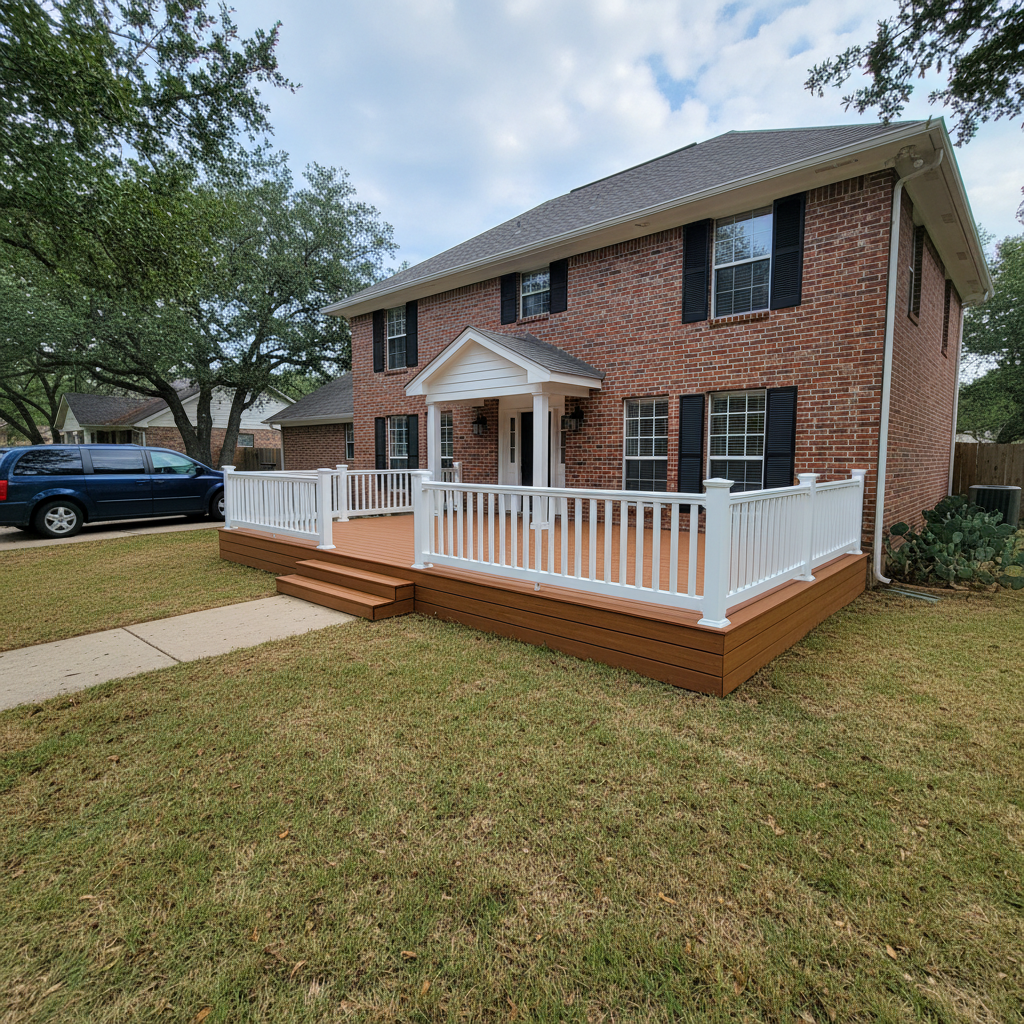
Picking a deck builder in McAllen isn't like picking one in Ohio or Oregon. The soil here moves. The summers cook lumber from the inside. And a lot of the advice you'll find online about decks assumes a freeze-thaw climate that doesn't apply to the Rio Grande Valley at all. Here's what actually matters when you're sitting across the table from a builder with a bid in your hand.
What the clay under your yard does to a deck's footings
Most of McAllen and the surrounding towns sit on heavy clay, sometimes with a caliche layer a couple feet down. That clay swells when it gets wet and shrinks hard when it dries out, and in the Valley you go from a wet August to a bone-dry April in the same year. A footing poured too shallow will heave and settle with that cycle, and a year or two in you'll see a post pull away from its beam or a corner of the deck start to sag.
A builder who knows the ground here sets footings at least 12 to 18 inches deep, often with a bell-shaped bottom to resist the upward push from expansive clay, and they'll tell you that without you having to ask. If someone's bid just says "concrete footings" with no depth and no mention of the soil, that's a bid written for a different state.
Heat, humidity and six months of storm season
McAllen runs well past 100 degrees for stretches of June through September, and the humidity off the Gulf doesn't let lumber dry out the way it would in a drier climate. Pressure-treated pine, which is what most framing here uses, needs fasteners rated for that moisture, not plain galvanized deck screws that'll start corroding in a couple years. Hot-dip galvanized or stainless fasteners cost more up front and save you from rust streaks and popped screw heads later.
Hurricane season runs June through November down here, and a deck attached to the house with a weak ledger board connection is a real liability in a storm, not a theoretical one. The ledger should be lag-bolted or through-bolted into the house framing with proper flashing behind it, not just nailed on. Ask how your builder attaches the ledger. If the answer is vague, that's the connection most likely to fail first.
The sun matters too. Composite decking handles McAllen heat better than wood over the long run because it doesn't crack and silver the way pine does after a few summers, but it still needs gapping for expansion, usually around 1/8 inch per board, because composite moves more than people expect in extreme heat.
Permits and inspections, and why skipping them costs you later
Most deck projects in the city of McAllen need a building permit, and that typically means an inspection of the footings before you pour concrete and another on the framing before the decking goes down. If a builder tells you permits aren't necessary for a deck this size, check that yourself before you believe it. An unpermitted deck can become a real problem when you go to sell the house and the buyer's inspector or the title company asks for permit records that don't exist.
If you're in one of the newer subdivisions out toward Sharyland or Tres Lagos, there's a decent chance you're also dealing with an HOA, and HOAs often have their own rules on deck height, materials and how close you can build to a property line. A builder who's worked in your neighborhood before will usually know this before you bring it up. One who's never asked whether you have an HOA probably hasn't built there.
Older lots versus new subdivisions
A lot of the older neighborhoods closer to downtown McAllen were built in the 1950s through 70s, and those lots sometimes have irrigation lines, old sewer laterals or unmarked utility runs that never made it onto a current survey. A builder digging footings there without calling for utility locates first is taking a risk with your yard, not just theirs.
Newer subdivisions on the edges of town are often built on what used to be farmland, with fill brought in to level the lot. Fill soil compacts unevenly, which is another reason footing depth and placement matter more here than a generic online deck calculator will tell you. A good builder treats every lot as its own problem, not a template.
Questions worth asking before you sign anything
- How deep are the footings going, and why that depth for this soil?
- Who pulls the permit, and is that cost already in the bid?
- What's the fastener spec, and is it rated for this climate?
- How is the ledger board attached to the house, and is it flashed?
- What's the lumber grade, and is it pressure-treated to ground contact rating for any post that touches soil?
A builder who answers these in plain language without reaching for a laptop knows the trade. One who talks around the question or just says "we do it the right way" every time hasn't actually thought about your specific lot.
What to walk away from
Walk away from a bid with no written scope, just a price. Walk away if they can't show proof of insurance, because if a worker gets hurt on a ladder over your patio, you don't want that liability landing on you. Walk away if the price is dramatically lower than everyone else's, since the corner they're cutting is usually footing depth, fastener grade or lumber quality, and those don't show up until year two or three. And walk away from anyone pushing you to skip the permit to save time, because that decision is yours to make with full information, not theirs to make for you quietly.
A deck that's framed right, set on footings that respect this clay, and built with fasteners that can take the humidity here will outlast a cheap one by a decade or more. That's the whole case for taking the time to choose carefully. You can see how we approach framing, footings and materials for this climate on our deck builder work around McAllen and the surrounding towns.